Palio di Siena
Twice each summer, Siena's medieval Piazza del Campo transforms into the arena for the Palio, one of Italy's oldest and most fiercely contested traditions. The August edition — the Palio dell'Assunta — is run on 16 August, honouring the Assumption of the Virgin Mary, with the race itself taking place in the evening, around 7pm.
Ten of Siena's seventeen historic contrade (city districts) compete, each represented by a horse assigned by lottery and a jockey chosen by the district. The race consists of just three breathless laps of the piazza's sand-and-tuff track — often over in under 90 seconds — but the spectacle around it unfolds over four days, from 13 to 16 August, encompassing trial races, ceremonial blessings of the horses inside each contrada's chapel, and the Historical Parade, a procession of Renaissance costume, flag-throwing and pageantry that precedes the race itself.
For the Sienese, the Palio is not tourism — it's identity, rivalry and faith bound into a single event that's remained essentially unchanged since 1633. For visitors, it's one of the most intense, atmospheric spectacles in European sport, best experienced from a balcony or window seat overlooking the square, which sell out many months in advance.
Buy Tickets
- Buy Tickets
-
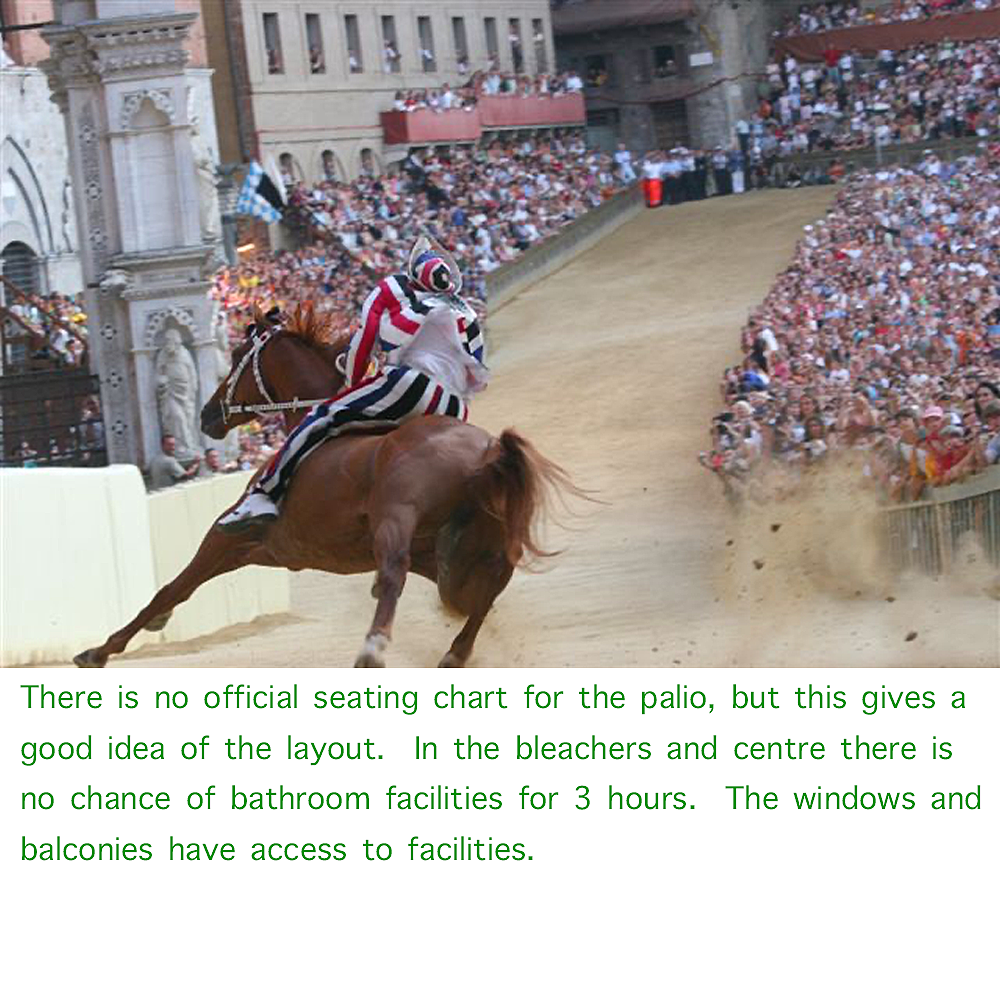
Seating Chart
-
Palio dell'Assunta — Siena, 16 August
Twice each summer, Siena's medieval Piazza del Campo transforms into the arena for the Palio, one of Italy's oldest and most fiercely contested traditions. The August edition — the Palio dell'Assunta — is run on 16 August, honouring the Assumption of the Virgin Mary, with the race itself taking place in the evening, around 7pm.
Ten of Siena's seventeen historic contrade (city districts) compete, each represented by a horse assigned by lottery and a jockey chosen by the district. The race consists of just three breathless laps of the piazza's sand-and-tuff track — often over in under 90 seconds — but the spectacle around it unfolds over four days, from 13 to 16 August, encompassing trial races, ceremonial blessings of the horses inside each contrada's chapel, and the Historical Parade, a procession of Renaissance costume, flag-throwing and pageantry that precedes the race itself.
For the Sienese, the Palio is not tourism — it's identity, rivalry and faith bound into a single event that's remained essentially unchanged since 1633. For visitors, it's one of the most intense, atmospheric spectacles in European sport, best experienced from a balcony or window seat overlooking the square, which sell out many months in advance.